
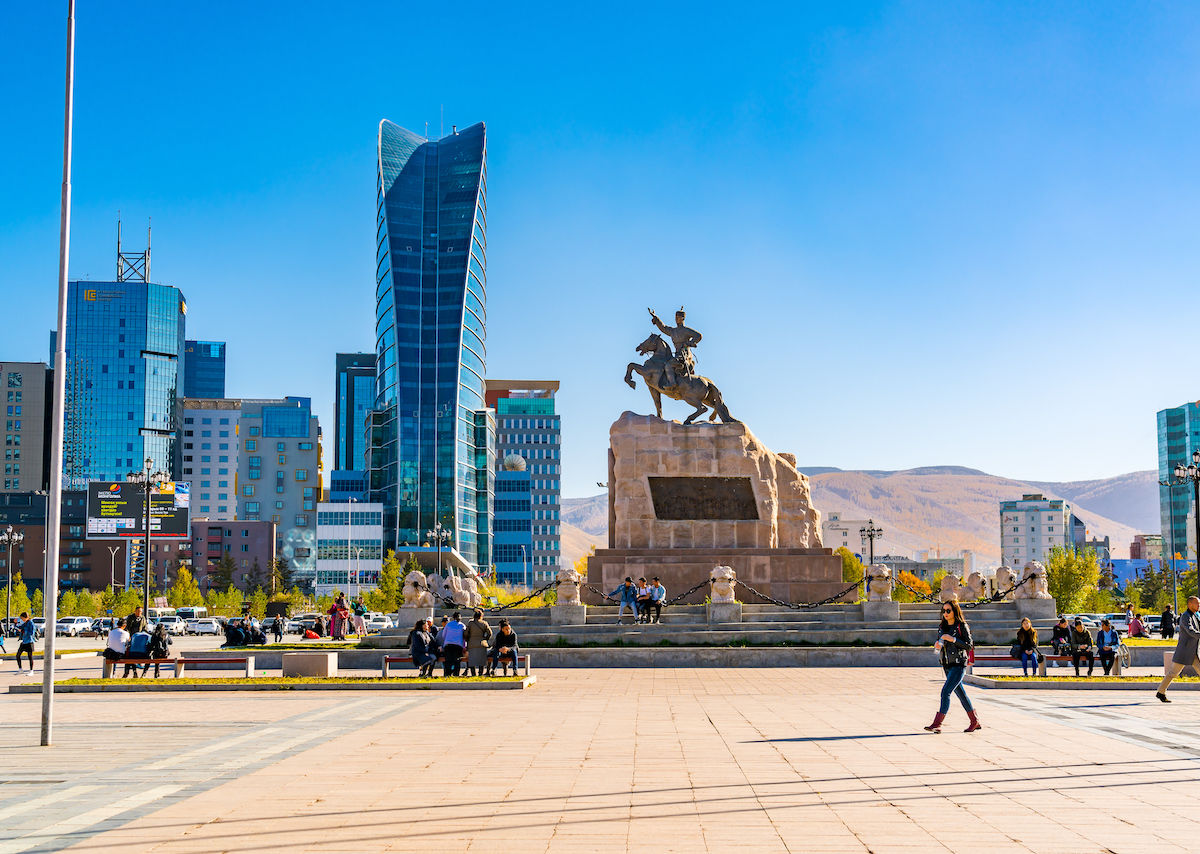
Ulaanbaatar is a city that underwent rapid modernization in the 20th century and is home to more than half of Mongolia’s population. It is a city with a rich history and is very popular. Moreover, there are interesting facts about it that remain relatively unknown.
Let’s discover together five surprising facts about Ulaanbaatar!
The coldest capital in the world
When imagining the coldest capital in the world, people usually think of Moscow, but it only ranks third. In fact, Ulaanbaatar holds the title of the coldest capital in the world, with an average annual temperature of -1.3°C. January is often the coldest month of the year. Occasionally, nighttime temperatures can drop as low as -40°C. However, during the rest of winter, temperatures are more manageable for sightseeing, hovering around -20°C.
“Ulaanbaatar” is not the original name of the capital
“Ulaanbaatar” or “Ulan Bator,” as it is most commonly spelled, is not the original name of the Mongolian capital. Initially, it was known as Örgöö (Urga) when it was founded in 1639 as the seat of the first Bogd Zanabazar, the country’s religious leader. The current name, Ulaanbaatar, meaning “Red Hero,” was adopted in October 1924—three years after the People’s Revolution, which freed the country from foreign influence.
It experienced three revolutions in the 20th century
The 20th century was a period in history that saw newly independent states emerge at an unprecedented pace. Mongolia also had its share of struggles for independence. In 1911, Mongolia was liberated from 200 years of Manchu occupation. The second revolution took place in 1924, which saw Ulaanbaatar (then Urga) freed from the Chinese Kuomintang troops and the White Army led by Baron Ungern. The last revolution occurred in 1990, leading to the emergence of a young and democratic government. This revolution was remarkable because the transition of power occurred without civil conflict, even as several wars were spreading worldwide.
It is served by the Trans-Siberian Railway
One of the best ways to travel across Mongolia is by train. The Trans-Siberian Railway offers a direct connection between Beijing and Moscow. The route passes through Ulaanbaatar, providing a chance to experience the best of all three countries in a single journey. In recent decades, many tour operators specializing in the Trans-Siberian route have enjoyed great success.
The most nomadic city in the world
When founded in 1639, the city was created as a mobile monastic center and was located about 350 km from its current location. It was always moved strategically along trade routes between Russia and China. Sources differ on the exact number of times and locations the city was relocated in the past, but it is clear that it was moved between 28 and 32 times before finally settling at its current location at the confluence of the Tuul and Selbe Rivers in 1778.


Comment (0)