

Shamanism is a practice that involves a practitioner reaching altered states of consciousness to interact with the world of spirits. The term “shamanism” was first applied by Western anthropologists as outside observers of the ancient religion of the Turks and Mongols, and those of the neighboring Tungstic- and Samoyedic-speaking people. Fundamental belief of shamanism is that the universe is alive: all living beings have a conscious soul animating them – humans, animals, birds, insects, reptiles, plants, etc. A shaman is someone who has access to the world of spirits, enters into a trance state during a ritual, practices divination and healing with the help of spirits.

From archeological discoveries of the Neolithic period and from the Secret History of the Mongols, we know there was a system of beliefs in Mongolia whose essential qualities included ecstasy and the ability to combat harmful forces and to look into the future to foreshadow, through the help of ancestral spirits. During the time of Genghis Khan in the 13th century, shamanism was the main religious system in Mongolia’s vast steppe. Before each battle, shamans were invited to call the grace for the warriors and prophesy its development. There are many Mongolian and non-Mongolian accounts mentioning weather-magic rituals performed by shamans against the enemy’s army, bringing storms and lightning as metaphorical weapons in war. The Secret history of the Mongols mentions a case of Genghis Khan’s court shaman who was politically so powerful that he had to be eliminated. The Mongols knew Buddhism at that time, and Marco Polo reported that monks were competing with court shamans, but the influence of this religion coming from Tibet was not very deep amongst neither the khans nor the public.
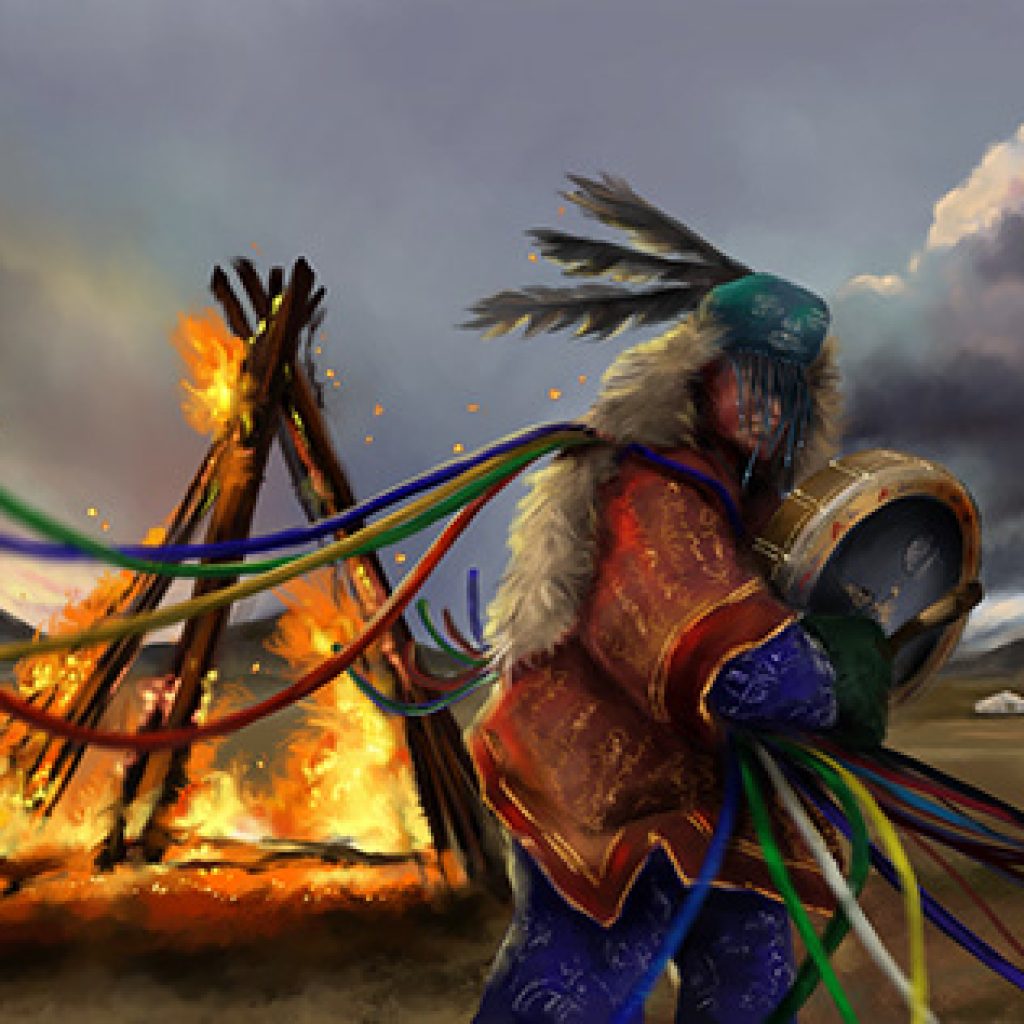
It is only from the 16th century that Buddhism, adopted by Altan Khan, descend from Genghis Khan, started its official spread. Slow but progressive conversion of the Mongols to the new religion has been possible by editing laws against ancient religious practices and adapting Buddhist precepts to an existing system of beliefs. It has been a smart strategy adopted by Buddhism, which consisted in infiltrating leader’s stratum to make apply favorable laws to its expansion and then to settle down deeper by mixing with the present existing Shamanistic roots. The first law was the prohibition of any flesh and blood offerings. Then, ongod, small figurines, which are spirit supports or vessels, and were worshipped as domestic gods, protecting flocks and people, were piled up and set to fire. Shamanic items were swapped with the images of Buddha while traditional prayers were replaced by Buddhist mantras. Buddhist monks took over the ritualistic sphere and progressively became the official religion to the detriment of Shamanism.



Comment (0)